What Is PU Leather? The Complete Guide to Polyurethane Leather

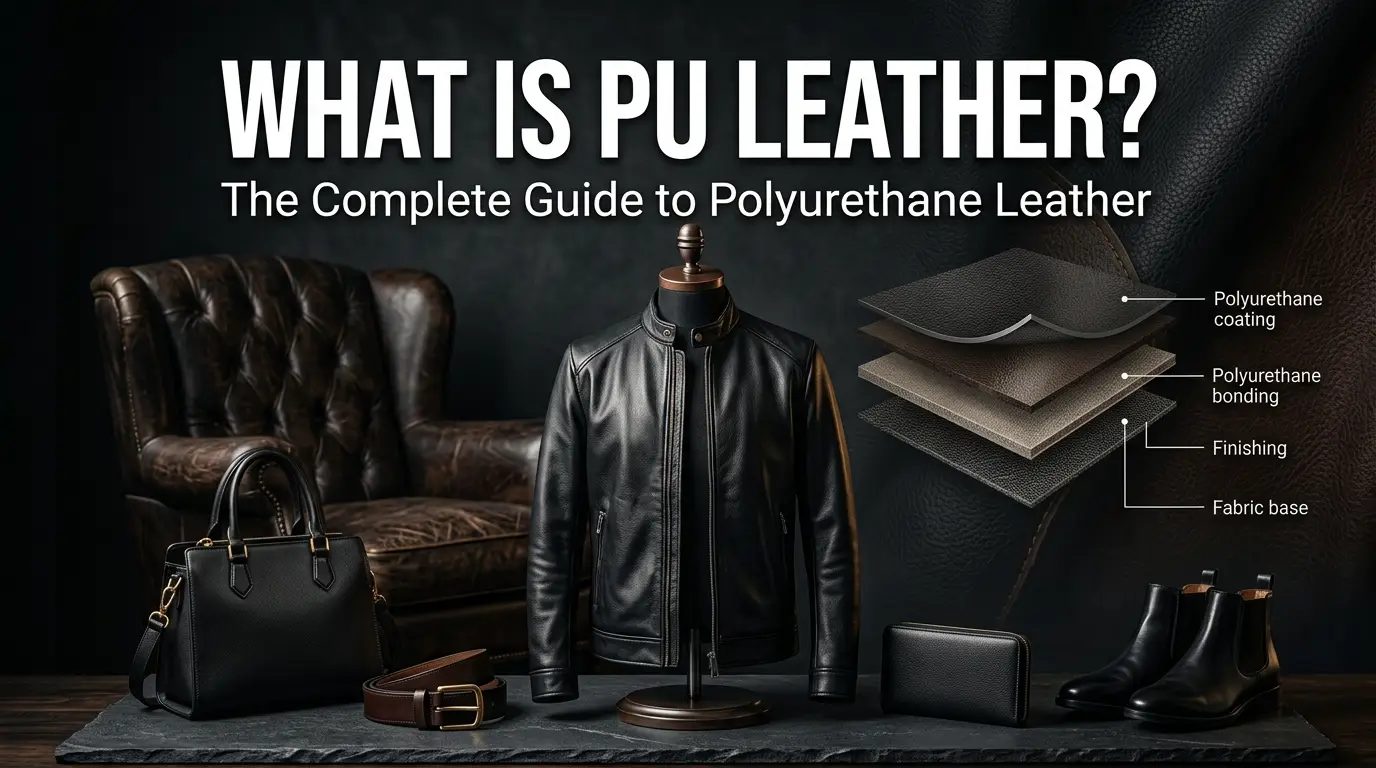
PU leather, short for polyurethane leather, is a fully synthetic material made by coating a fabric base typically cotton, polyester, or nylon with a flexible polyurethane polymer. It is completely animal-free, making it widely used as a vegan alternative to genuine leather in jackets, bags, shoes, and furniture. PU leather is also sold under the names faux leather, synthetic leather, vegan leather, leatherette, skai, and pleather. This complete guide covers exactly what PU leather is, what it is made of, how it compares to genuine leather, whether it is truly vegan, how long it lasts, and everything a buyer needs to know before purchasing a PU leather jacket or product. For a broader overview of all leather types and grades including genuine, full-grain, and bonded leather, read the complete what is leather made of guide at TV Jackets.
What Does PU Leather Mean?
PU leather stands for polyurethane leather. Polyurethane is a type of flexible plastic polymer that can be manufactured in a wide range of textures, colors, and finishes. When applied as a coating over a woven fabric base, it creates a material that closely resembles the appearance of animal leather at a significantly lower cost. The term PU leather is used commercially to describe the finished product, regardless of whether the base material is cotton, polyester, nylon, or rayon.
PU leather belongs to the broader category of artificial leather, which covers all synthetic and semi-synthetic materials designed to replicate genuine leather. According to Wikipedia’s entry on artificial leather, the development of polyurethane-coated fabrics in the mid-twentieth century was a significant turning point in the affordable fashion and furniture industries. The polyurethane polymer itself was invented by Professor Dr. Otto Bayer at IG Farben in Germany in 1937, though its widespread use in consumer fashion began in the 1960s.
Full-Synthetic vs Semi-Synthetic PU Leather
There are two distinct types of material sold under the PU leather label, and the difference matters significantly for vegan and ethical buyers.
Full-synthetic PU leather uses a woven fabric base (polyester, cotton, or nylon) with a polyurethane coating applied directly to the fabric. It contains no animal material of any kind and is genuinely vegan and cruelty-free.
Semi-synthetic PU leather, known as bicast leather or split leather, uses the fibrous inner section of a real animal hide as the base layer and applies a polyurethane coating over it. This creates a smooth, uniform surface that looks identical to full-synthetic PU leather but contains actual animal by-products. Bicast leather is sometimes marketed under vegan leather or PU leather labels, which creates confusion for buyers. Always check for a “100% synthetic” or “vegan-certified” label if animal-free materials matter to you.
Other Names for PU Leather
PU leather is sold and marketed under many different names. Knowing these alternate terms prevents confusion when shopping across different brands and retailers:
- Faux leather — broad umbrella term covering all synthetic leather alternatives
- Synthetic leather — general technical description
- Vegan leather — ethical positioning used for 100% synthetic products
- Leatherette — older commercial term, common in furniture and automotive
- Skai — brand name widely used in German-speaking markets for synthetic leather
- Pleather — informal term combining plastic and leather
- Bicast leather — semi-synthetic variant with animal hide base
- Bonded leather — lower-grade variant made from shredded leather scraps
- Artificial leather — technical and scientific classification
How Is PU Leather Made?
Understanding the manufacturing process of PU leather helps explain its properties, durability characteristics, and limitations compared to genuine leather.
What Is PU Leather Made Of?
PU leather is made from two primary components. The first is a woven fabric base, typically polyester, cotton, nylon, or rayon. The fabric base provides the structural foundation and flexibility of the finished material. Higher-quality PU leather uses denser, stronger fabric bases that resist tearing and contribute to a longer lifespan. The second component is polyurethane, a flexible plastic polymer derived from petroleum. Polyurethane is applied as a liquid coating to the fabric base and cured into a solid, flexible layer that forms the surface of the material.
The full manufacturing process follows four main stages according to VonBaer’s manufacturing guide:
- Stage 1: Base fabric preparation — the woven fabric is cleaned, tensioned, and prepared for coating application
- Stage 2: Polyurethane coating lamination — liquid polyurethane resin is applied to the fabric at high pressure and temperature, bonding the polymer to the fabric fibres
- Stage 3: Grain pattern embossing — the coated material passes through a roller engraved with a grain pattern to simulate real leather texture. The pattern can replicate full-grain leather, pebbled leather, saffiano, or exotic leather grains
- Stage 4: Dyeing and finishing — the surface is dyed, pigmented, and finished with protective treatments for color stability, UV resistance, and surface hardness
Because the manufacturing process is fully industrial, PU leather can be produced in consistent thickness, color, and texture across large quantities. This consistency is one of its commercial advantages over genuine leather, where each hide varies naturally.
PU Leather vs Real Leather vs PVC Leather: Full Comparison
The most common questions buyers have about PU leather involve how it compares to genuine animal leather and to PVC, the other major synthetic leather alternative. The three materials differ significantly in durability, feel, breathability, vegan status, maintenance requirements, and long-term value. This table covers all three side by side.
| Feature | PU Leather | Genuine Leather | PVC Leather |
|---|---|---|---|
| Source material | Polyurethane polymer over fabric base | Animal hide (cattle, sheep, goat) | Polyvinyl chloride over foam layer |
| Lifespan | 1 to 7 years | 10 to 30+ years | 3 to 10 years |
| Breathability | Low — plastic coating traps heat | High — natural pores allow airflow | Very low — least breathable of the three |
| Flexibility | High — soft and supple | High — improves with wear | Low — stiff, especially in cold temperatures |
| Water resistance | Water-resistant (not waterproof) | Varies by grade and treatment | Highly water-resistant |
| Aging | Cracks, peels, loses flexibility | Develops patina, improves with age | Cracks and becomes brittle over time |
| Patina development | No | Yes — natural aging adds character | No |
| Vegan | Yes (100% synthetic only) | No | Yes |
| Toxicity | Lower — petroleum-based, BPA-free | Tanning chemicals (chromium, ammonia) | Higher — chlorine-based, releases VOCs |
| Maintenance | Damp cloth, mild soap, no conditioning | Regular conditioning required | Damp cloth, minimal care needed |
| Cost | Affordable | Premium to expensive | Affordable to mid-range |
| Best use case | Fashion jackets, bags, accessories | Premium jackets, long-term investment pieces | Heavy-use upholstery, vinyl applications |
The most significant long-term difference across all three materials is how each ages. Genuine leather develops a patina, a natural sheen acquired through use, skin oils, and time, that makes high-quality leather more characterful the longer it is worn. Full-grain leather jackets are considered investment pieces precisely because they improve with decades of wear. PU leather has no equivalent aging process. Instead of developing character, the polyurethane coating gradually degrades through cracking, peeling, and color loss. PVC leather follows a similar degradation path but tends to become brittle rather than peeling, particularly in cold temperatures where the rigid polymer loses flexibility faster.
PU Leather vs Faux Leather: Are They the Same?
Faux leather is a broad umbrella term covering all synthetic leather alternatives, including PU leather, PVC leather, bonded leather, and plant-based leathers. PU leather is one specific type of faux leather, the most common one, distinguished by its polyurethane coating over a fabric base. All PU leather is faux leather, but not all faux leather is PU leather. The two terms are often used interchangeably in retail and fashion contexts, but they are not technically identical.
PU Leather vs Bonded Leather
Bonded leather is sometimes confused with PU leather but is a different and lower-grade material. Bonded leather is made from shredded leather scraps and fibers that are glued together onto a paper or fabric backing and coated with polyurethane. It typically contains only 10 to 20 percent actual leather content. Bonded leather peels and degrades faster than even low-quality PU leather, making it the weakest performer in the synthetic leather category. PU leather is more durable, more consistent, and structurally more reliable than bonded leather.
Is PU Leather Vegan?
100% PU leather is fully vegan and cruelty-free. Its production uses no animal hides, no animal by-products, and no animal-derived extracts. The material is entirely petroleum-based and synthetic from fabric base to surface coating.
However, the vegan status of PU leather products depends entirely on which type of PU leather is used. Bicast leather, sometimes called split leather, uses the fibrous inner layer of a real animal hide as its base before the polyurethane coating is applied. This makes bicast leather semi-synthetic and not fully vegan, despite often being marketed or labeled under vegan leather or PU leather terms. For ethical buyers, this distinction is critical.
The reliable way to confirm vegan status is to look for a “100% synthetic” or “vegan-certified” label on the product tag. If the label simply says “PU leather” or “faux leather” without specifying 100% synthetic construction, the product may contain bicast leather components. According to Rahui London’s guide to vegan leather types, the greenwashing concern around PU leather is real, as animal-free production does not automatically mean environmentally responsible production.
The Pros and Cons of PU Leather
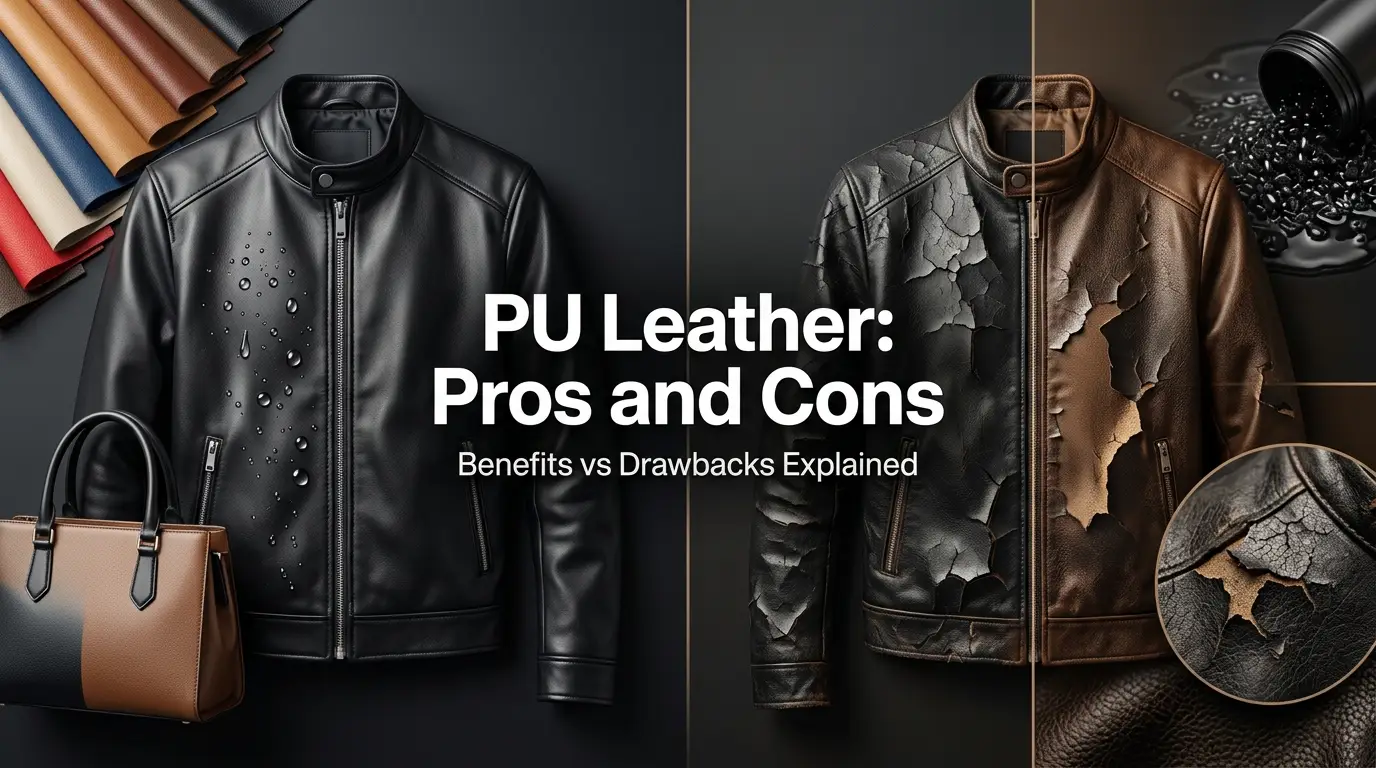
PU leather benefits on the left versus drawbacks including cracking and peeling on the right at TV Jackets
Benefits of PU Leather
- Affordability: PU leather costs significantly less to produce than genuine leather, making it accessible across a wide range of price points
- Water-resistant: The polyurethane coating repels light moisture and makes spills easy to wipe off without causing staining
- Vegan and cruelty-free: 100% PU leather contains no animal products, making it the dominant choice for ethical fashion
- Easy maintenance: PU leather requires no conditioning, no specialist cleaning products, and minimal upkeep compared to genuine leather
- UV resistance: PU leather is more resistant to UV fading than genuine leather, making it better suited for products exposed to sunlight
- Color and texture variety: Because the surface is manufactured industrially, PU leather can be produced in virtually any color, texture, or pattern, including exotic leather grain simulations
- Consistent appearance: Unlike genuine leather where each hide varies, PU leather offers uniform color and texture across entire product runs
Drawbacks of PU Leather
- Limited lifespan: PU leather typically lasts one to seven years before cracking, peeling, or discoloring, compared to decades for quality genuine leather
- Low breathability: The plastic coating traps heat and moisture against the skin, making PU leather less comfortable than genuine leather for extended wear
- No patina development: PU leather does not age gracefully. It degrades rather than developing character over time
- Plastic smell: New PU leather products often carry a chemical or plastic odor, though this typically fades with time. Some manufacturers infuse artificial scents to mimic genuine leather aroma
- Environmental concerns: PU leather is petroleum-derived and non-biodegradable, raising sustainability concerns despite its animal-free credentials
- Peeling and cracking: As the polyurethane layer breaks down, PU leather peels away from its backing in sheets, particularly at seams, stress points, and areas of frequent flexing
How Long Does PU Leather Last?
PU leather typically lasts between one and seven years depending on quality, usage, and care. Unlike genuine leather, which develops a patina and improves with age, PU leather degrades by cracking, peeling, and losing flexibility as the polyurethane layer breaks down over time.
The quality range within PU leather is wide. Budget PU leather products, made with thin polyurethane coatings and lower-grade fabric bases, may begin showing cracks and peeling within one to two years of regular use. Premium PU leather, made with thicker resin layers, stronger fabric bases, and additional finishing treatments, can last five to seven years or more with proper care. The failure typically begins at stress points first, where the material flexes repeatedly, such as jacket elbows, sofa armrests, wallet fold lines, and handbag handles.
Soft PU leather is thinner and more flexible, making it well-suited for fashion items like jackets and travel bags where drape and movement matter. Premium PU leather receives additional treatments for strength and realism and is used in higher-end bags, furniture, and automotive upholstery. For jacket buyers, soft PU leather in a mid-to-high quality construction gives the best balance of wearability and durability.
Is PU Leather Waterproof?
PU leather is water-resistant but not waterproof. The polyurethane coating provides a protective barrier that repels light moisture and makes spills easy to wipe clean. However, prolonged or heavy water exposure can seep through the material and cause damage, so PU leather should not be submerged or left in sustained rain.
In practical terms, this means a PU leather jacket handles light rain, splashes, and accidental spills well. The surface can be wiped dry and the material will not be damaged by brief water contact. However, a sustained downpour will eventually penetrate the material, especially at seams and stitching points where the coating is thinner. For true waterproofing in outdoor or technical applications, materials such as neoprene or Gore-Tex are required. PU leather is not a substitute for purpose-built waterproof outerwear.
Is PU Leather Toxic?
PU leather as a finished consumer product is generally considered non-toxic and BPA-free. Under normal conditions of use, a PU leather jacket, bag, or piece of furniture does not emit harmful chemicals at levels considered dangerous to the user.
The manufacturing process is a different matter. Producing PU leather can involve dimethylformamide (DMF), a solvent that has been linked to birth defects and liver damage under industrial exposure conditions. VOCs (volatile organic compounds) and dioxins may also be released during production. Some manufacturing facilities, particularly in regions with less stringent industrial regulation, have been associated with worker health risks and environmental contamination from these chemical byproducts.
PVC leather carries greater toxicity concerns than PU leather. PVC production involves chlorine-based chemistry and releases more toxic compounds both during manufacturing and at end of life. Heavy metals including lead and cadmium have been identified in some lower-quality synthetic leather products from unregulated sources. For standard consumer use, reputable PU leather products from responsible manufacturers present no significant toxicity risk in the finished state.
The Environmental Impact of PU Leather
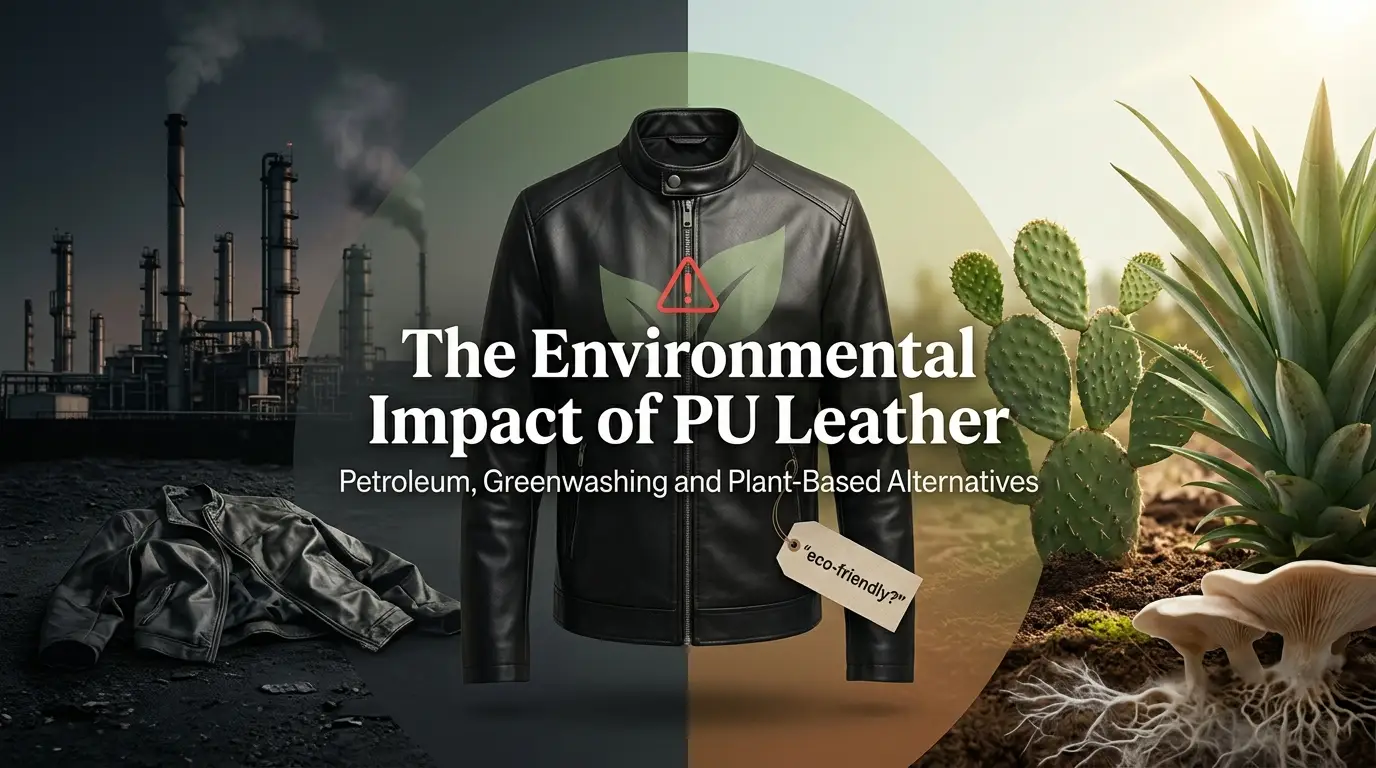
PU leather environmental trade-off from petroleum production to plant-based alternatives like Desserto and Pinatex
PU leather is often positioned as an eco-friendly alternative to genuine leather because it involves no animal slaughter. The environmental reality is more complex. PU leather is a petroleum-derived product, meaning its production consumes fossil fuels and releases carbon emissions during manufacturing. It is also non-biodegradable, taking hundreds of years to break down in landfill conditions.
Genuine leather, by comparison, has a high production carbon footprint driven by cattle farming methane emissions and land use. However, vegetable-tanned leather biodegrades within 25 to 40 years, giving it a significantly lower end-of-life environmental footprint than PU leather.
The greenwashing concern is real. Marketing PU leather as an environmentally responsible choice purely because it is animal-free oversimplifies the environmental trade-off. A PU leather jacket that lasts two years before being discarded has a higher total environmental cost than a full-grain leather jacket maintained for twenty years, even accounting for the production footprint of genuine leather.
Plant-based leather alternatives including pineapple leaf leather (Pinatex), cactus leather (Desserto), and mycelium leather offer genuinely lower environmental footprints than both PU leather and conventional animal leather, though they remain more expensive and less widely available.
Can PU Leather Be Recycled?
PU leather is partially recyclable in theory. The polyurethane material can be broken down and reprocessed into other products such as insulation material or carpet padding. However, the recycling process is energy-intensive and the infrastructure to handle PU leather at scale is limited in most regions. In practice, the vast majority of end-of-life PU leather products go to landfill rather than being recycled. The non-biodegradable nature of the polyurethane layer means this waste persists in the environment for a very long time.
How to Identify PU Leather
Knowing how to tell PU leather from genuine leather is a practical skill for any buyer. Several reliable tests can be applied before or after purchase:
- Check the label: The most reliable method. Look for “100% synthetic,” “PU leather,” or “polyurethane.” Genuine leather products will typically say “genuine leather,” “full-grain leather,” or “top-grain leather.” No label or a vague label is itself a warning signal.
- Visual inspection: Real leather has natural variations in grain pattern, subtle blemishes, and irregular texture. PU leather has a perfectly uniform, repeated pattern with no natural variation across the entire surface.
- Feel the texture: Real leather feels warm and slightly flexible. PU leather often feels cooler and plasticky to the touch, and may feel slightly rigid or stiff when new.
- The smell test: Real leather has a distinctive, organic, slightly animal aroma that is difficult to replicate. PU leather smells of plastic or chemicals, particularly when new. Some manufacturers add artificial leather scents to PU products.
- The water drop test: Place a small drop of water on the surface. Real leather slowly absorbs it. PU leather repels it, leaving the water sitting on the surface.
- The edge test: Real leather has a rough, fibrous edge when cut. PU leather shows a clean, plastic-like edge or a layered structure where the coating separates from the fabric backing.
- The burn test (use with caution): Real leather burns like organic material and smells like burning hair. PU leather melts and produces a plastic smell. Only attempt this on a hidden or scrap area, never on a product you intend to keep.
For a broader guide to identifying different leather types and grades, BTOD’s PU leather guide provides a thorough breakdown of identification methods across product categories.
How to Care for and Clean PU Leather
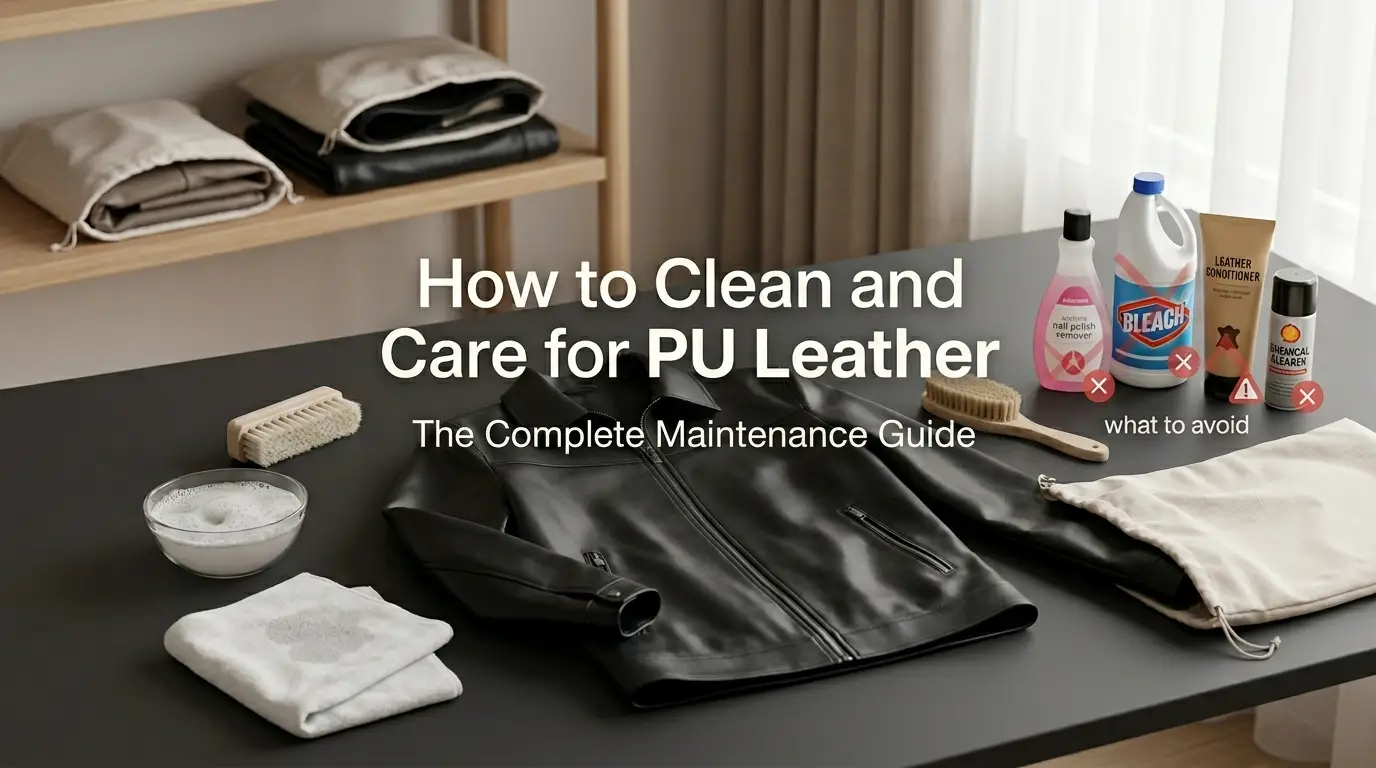
PU leather care guide showing proper cleaning tools and what to avoid to keep synthetic leather in top condition
PU leather is considerably easier to maintain than genuine leather and requires no specialist leather care products:
- Daily cleaning: Wipe with a soft damp cloth to remove surface dust and light dirt
- Deeper cleaning: Mix a small amount of mild soap with warm water and apply with a soft non-abrasive cloth. Wipe dry afterwards.
- What to avoid: Harsh chemical cleaners, acetone, bleach, and oil-based leather conditioners all degrade the polyurethane coating and accelerate peeling and cracking
- No conditioning required: Unlike genuine leather, PU leather has no natural fibres to moisturise. Applying leather conditioner to PU leather does nothing beneficial and may damage the surface
- Sunlight and heat: Store PU leather away from direct sunlight and heat sources. UV exposure and heat accelerate the breakdown of the polyurethane layer, causing the surface to become brittle, crack, and peel faster
- Storage: Store PU leather products in a cool, dry place. Do not store in plastic bags or airtight containers as moisture buildup can cause mold. A breathable dust bag or open shelf is preferable
- Sharp objects: Avoid contact with sharp objects as PU leather tears more easily than genuine leather once the surface coating is compromised
Common Uses of PU Leather
PU leather is one of the most versatile synthetic materials in the fashion and furniture industries. Its combination of affordability, water resistance, and vegan credentials makes it suitable across a wide range of product categories.
PU Leather in Jackets and Fashion
PU leather is widely used in fashion jackets, bags, belts, wallets, and accessories. In the jacket category, it offers a genuine leather appearance at a fraction of the cost. For buyers who want the visual and tactile experience of a leather jacket without the price premium of full-grain or top-grain leather, or who prefer animal-free materials, PU leather jackets are the dominant choice in the affordable to mid-range market.
The key factors to look for when buying a PU leather jacket are the thickness and quality of the polyurethane coating, the density of the fabric base, and the quality of the stitching and construction at stress points. A well-made PU leather jacket with a thick resin layer and strong polyester base will give several years of regular wear. Browse the full range of mens leather jackets and womens leather jackets at TV Jackets for character-inspired and fashion-forward outerwear across real and vegan leather constructions.
PU Leather in Shoes: What Does PU Upper Mean?
In footwear, the term “PU upper” refers to the outer layer of the shoe being made from polyurethane leather. PU uppers are common in affordable fashion footwear, where the material provides a leather-like appearance without the cost of genuine leather. The main practical limitation of PU in shoes is breathability. Because polyurethane does not allow air circulation the way genuine leather does, PU-upper shoes can cause feet to heat up during extended wear.
Other Common Uses
Beyond fashion, PU leather is widely used in furniture upholstery (sofas, chairs, headboards), automotive interiors (seat covers, dashboards, door panels), book covers and stationery, and kitchen and bar seating where easy cleaning of spills is a priority. Its water resistance and low maintenance requirements make it particularly popular in commercial hospitality settings.
Final Thoughts
PU leather is a genuinely useful material for buyers who want a leather-like appearance at an accessible price, prefer animal-free products, or need water-resistant outerwear that is easy to clean and maintain. Its limitations are equally genuine: a shorter lifespan than real leather, lower breathability, no patina development, and an environmental footprint that complicates its eco-friendly positioning despite being animal-free.
Understanding the difference between full-synthetic PU leather and semi-synthetic bicast leather matters for anyone making an ethical or vegan purchasing decision. Checking for the “100% synthetic” or “vegan-certified” label before buying is the single most important step a buyer can take to confirm the material is what it claims to be.
For buyers who want to understand the full landscape of leather types and grades before deciding, the complete what is leather made of guide at TV Jackets covers every grade from full-grain to bonded leather alongside all synthetic alternatives in one place.