
What Is Faux Leather? Everything You Need to Know Before Buying

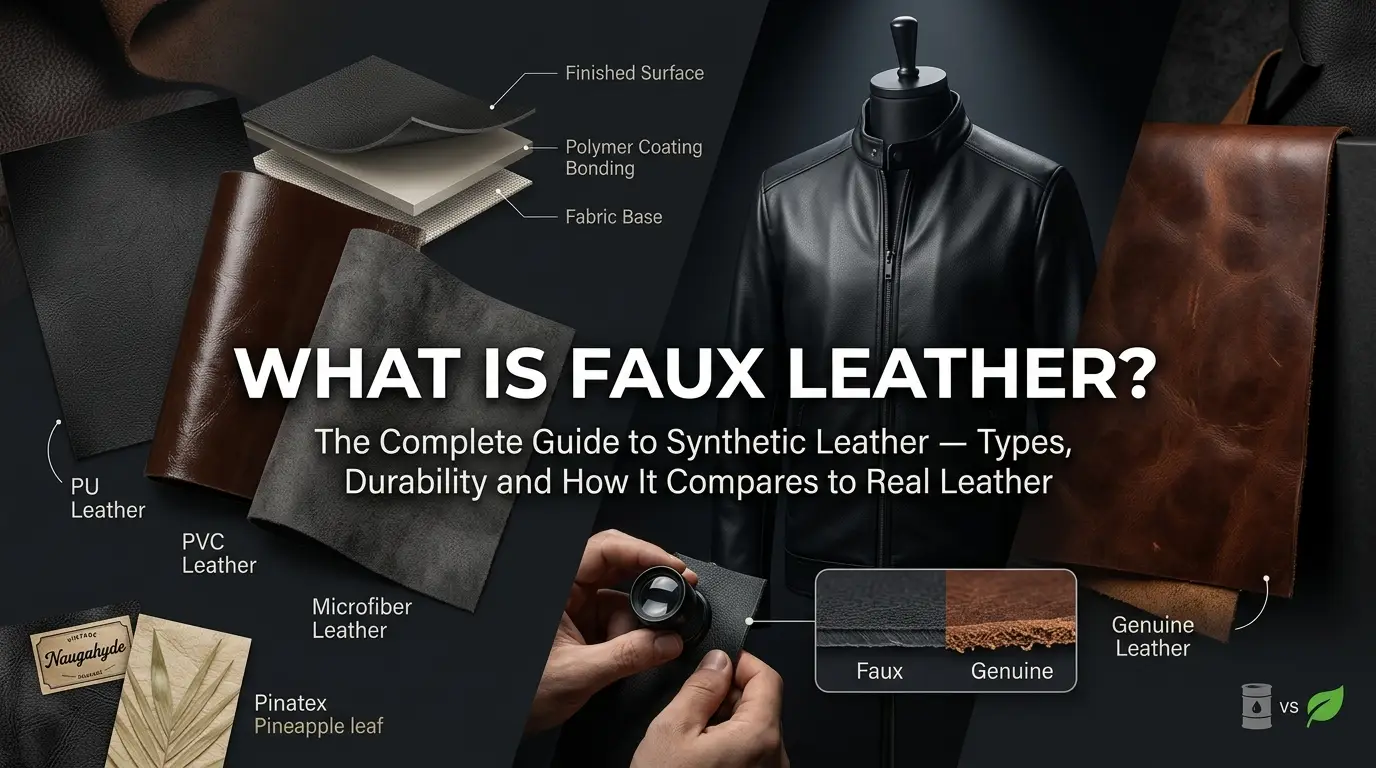
Faux leather is a synthetic, man-made material designed to mimic the look, feel, and appearance of genuine animal leather. Also known as synthetic leather, vegan leather, artificial leather, and pleather, it is made by coating a fabric base typically polyester or cotton with a plastic polymer such as polyurethane (PU) or polyvinyl chloride (PVC) to replicate the texture and appearance of real leather. This complete guide covers exactly what faux leather is, what it is made of, every type available, how it compares to genuine leather, how long it lasts, how to identify it, and everything a buyer needs to know before purchasing a faux leather jacket or product. For a full overview of all leather types and grades including genuine, full-grain, and bonded leather alongside their synthetic alternatives, read the complete what is leather made of guide at TV Jackets.
What Is Faux Leather?
Faux leather is a synthetic, man-made material produced to replicate the visual and tactile qualities of genuine animal leather without using animal hides in its production. According to Wikipedia’s entry on artificial leather, faux leather belongs to the broader category of artificial leather a class of synthetic and semi-synthetic materials that have been developed as alternatives to genuine leather since the 19th century. Faux leather is not a single material but rather a category covering several distinct product types, each made through different manufacturing processes and suited to different applications.
The material is created by taking a woven or non-woven fabric base and applying one or more layers of a plastic polymer most commonly polyurethane or polyvinyl chloride to the surface. The polymer is then embossed with a grain pattern to simulate the texture of real leather. The result is a material that can closely resemble the appearance of genuine leather at a fraction of the cost, using no animal products in its production.
The Many Names of Faux Leather
Faux leather is sold and marketed under a wide range of names depending on the context, brand, and material type. Knowing these alternate terms prevents confusion when researching or shopping:
- Synthetic leather — the general technical classification covering all man-made leather alternatives
- Artificial leather — the scientific and reference term, used by Wikipedia and industry standards bodies
- Vegan leather — the ethical positioning used for products that contain no animal materials
- PU leather — faux leather made with a polyurethane polymer coating, the most common type
- PVC leather — faux leather made with a polyvinyl chloride coating, harder and more water-resistant than PU
- Leatherette — older commercial term widely used in furniture and automotive upholstery
- Pleather — informal slang combining plastic and leather, often carrying a negative connotation
- Imitation leather — general descriptive term used in retail and garment labeling
- Naugahyde — the brand name of the first commercially successful synthetic leather, introduced in 1920 by the U.S. Rubber Company, now often used as a generic term for vinyl upholstery
- Skai — a prominent synthetic leather brand widely used in German-speaking markets
What Is Faux Leather Made Of?
Faux leather is made from two primary components: a fabric base and a plastic polymer coating. Understanding these two layers explains why faux leather looks like genuine leather but behaves very differently over time.
The Base Fabric Layer
The fabric base of faux leather is typically woven polyester, cotton, nylon, or rayon. This layer provides the structural foundation of the material its tear resistance, dimensional stability, and ability to hold the polymer coating in place. Higher-quality faux leather uses denser, heavier fabric bases that resist delamination and contribute to a longer product lifespan. According to Sewport’s faux leather fabric directory, the density and quality of the base material is one of the primary variables separating premium faux leather from budget alternatives. The fabric base typically costs $1 to $5 per yard at industrial scale, with the polymer coating and finishing processes accounting for the remainder of production cost.
The Plastic Coating: Polyurethane vs Polyvinyl Chloride
The outer surface of faux leather is created by applying a liquid plastic polymer to the fabric base under heat and pressure. The two dominant polymer types are polyurethane (PU) and polyvinyl chloride (PVC), each producing a materially different end product.
Polyurethane is a flexible, petroleum-based plastic polymer that creates a soft, supple surface when cured onto the fabric base. PU leather is more breathable than PVC, more flexible at low temperatures, and more comfortable against the skin, making it the dominant choice for clothing, fashion accessories, and handbags. PVC, or polyvinyl chloride, is a harder, more rigid plastic polymer that creates a highly water-resistant and scratch-resistant surface. PVC leather is more durable than PU in heavy-use applications but is less flexible, less breathable, and carries greater environmental and health concerns due to its chlorine-based chemistry. PVC production can release dioxins and phthalates chemicals associated with environmental harm and human health risks under industrial exposure conditions. Faux leather products typically cost between $10 and $25 per yard, with premium grades reaching higher price points depending on coating thickness and additional treatments.
Types of Faux Leather
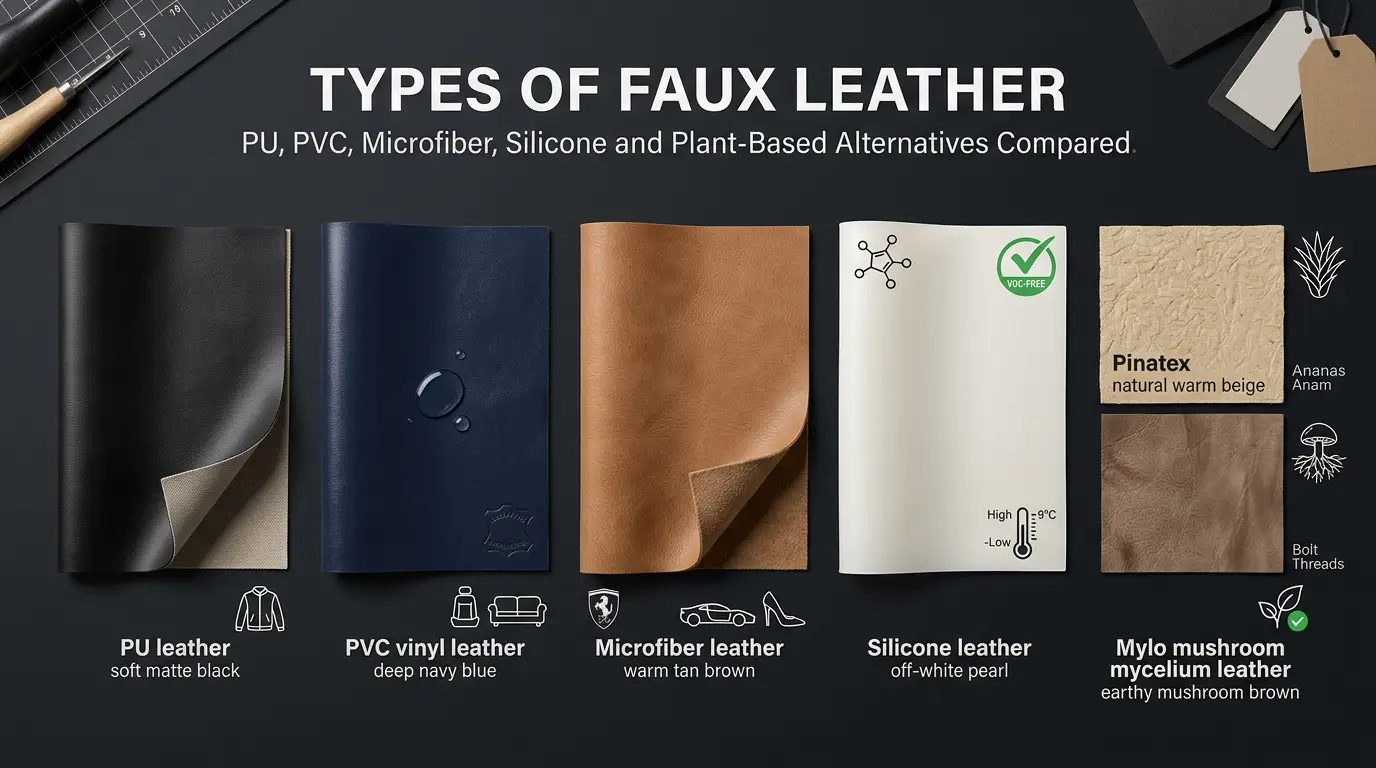
Faux leather types comparison: PU, PVC vinyl, microfiber, silicone and sustainable Pinatex alternatives at TV Jackets
Faux leather is not a single material. Several distinct types exist, each with different construction methods, physical properties, and best-use applications.
PU Leather (Polyurethane Leather)
PU leather, short for polyurethane leather, is the most widely used type of faux leather. It is softer, more flexible, and more breathable than PVC leather, making it the preferred choice for clothing, fashion accessories, and furniture upholstery where comfort and a realistic leather feel are priorities. PU leather is fully vegan, contains no animal products, and is generally considered the best available faux leather for fashion applications. For the complete deep-dive on polyurethane leather including how it is made, how it compares to genuine leather, how long it lasts, and how to care for it, read the complete what is PU leather guide at TV Jackets.
PVC Leather (Vinyl Leather)
PVC leather, also called vinyl leather, is a type of synthetic leather made from polyvinyl chloride bonded to a fabric base. It is harder and less breathable than PU leather but highly water-resistant and more durable in heavy-use scenarios, making it ideal for outdoor furniture, automotive interiors, and items that require sustained waterproofing. The harder surface of PVC makes it less comfortable as a clothing material, which is why it is rarely used in fashion jackets or wearable accessories. Naugahyde, one of the most recognizable brand names in synthetic leather history, is a form of vinyl leather that was first introduced in 1920 and became widely used in American diners, car seats, and public seating through the mid-20th century.
Microfiber Leather
Microfiber leather is a higher-grade type of synthetic leather made from ultra-fine polyester or nylon microfibers bonded with a polyurethane binder. Unlike standard PU or PVC leather, microfiber leather uses a non-woven fiber structure that creates a material with improved breathability, a more natural feel, and a more realistic grain texture than standard coated faux leathers. Microfiber leather is used in premium footwear, high-end upholstery, and accessories where a more convincing imitation of full-grain leather is required. Alcantara, the luxury microfiber suede brand used in Ferrari and McLaren car interiors and endorsed by major fashion houses, is one of the most prominent examples of a premium microfiber synthetic material. Clarino, produced by Kuraray Co., is another well-known microfiber synthetic leather brand widely used in footwear.
Silicone Leather
Silicone leather is a newer type of synthetic leather introduced around 2010 that uses an organic polymer silicone coating rather than PU or PVC. It produces no volatile organic compounds (VOCs) during manufacturing, making it a significantly cleaner production method than either PU or PVC. Silicone leather can be applied to virtually any surface and handles temperature extremes better than both polyurethane and polyvinyl chloride alternatives. It is currently produced in smaller volumes than PU or PVC and remains a niche material in the synthetic leather market, but it represents one of the most promising technical improvements in faux leather construction for applications where VOC emissions and temperature resistance are priorities.
Plant-Based and Sustainable Faux Leather Alternatives
A growing category of sustainable faux leather alternatives uses plant or fungal material rather than petroleum-based plastics as the primary input. These materials address the environmental concerns associated with PU and PVC production while maintaining an animal-free ethical position.
Pinatex, developed by Ananas Anam and designed by Dr. Carmen Hijosa, is a plant-based faux leather alternative made from compressed pineapple leaf fibers a by-product of pineapple farming that would otherwise be discarded. It has a natural, slightly textured surface and has been used in fashion collections by major brands. Mylo, produced by Bolt Threads, is made from mycelium the root network of mushrooms grown into sheets of material that closely resemble the texture and flexibility of genuine leather. Both Pinatex and cork leather are biodegradable, making them genuinely lower-impact alternatives to petroleum-based faux leathers. These materials remain more expensive and less widely available than PU or PVC leather but represent the direction the sustainable fashion industry is moving.
How Is Faux Leather Made?
The manufacturing process of faux leather follows three main stages that transform raw fabric and liquid polymer into finished synthetic leather material.
Step 1 — Obtaining and preparing the base material. The fabric base woven polyester, cotton, or nylon is cleaned, tensioned, and treated to prepare the surface for polymer adhesion. The quality and weave density of this base material directly determines the tear resistance and lifespan of the finished faux leather product.
Step 2 — Formulating and applying the plastic coating. For PU leather, polyurethane resin is dissolved into a solvent and applied as a liquid layer to the fabric base under heat and pressure, bonding the polymer to the fabric fibers and curing into a solid, flexible surface layer. For PVC leather, polyvinyl chloride is formulated from salt and petroleum derivatives and applied through a calendering process passing the coated fabric between heavy rollers to achieve a uniform thickness. The primary production countries for faux leather are China, South Korea, and Taiwan, with China accounting for the majority of global synthetic leather output.
Step 3 — Embossing and finishing. Once the polymer layer has cured, the material passes through a roller engraved with a grain pattern to emboss the surface with a texture simulating genuine leather full-grain, pebbled, saffiano, or exotic animal grain patterns are all commonly replicated. The surface is then dyed, pigmented, and finished with protective treatments for UV resistance, color stability, and surface hardness. The finished material is then cut and shipped to manufacturers.
Faux Leather vs Real Leather: Full Comparison
The most important decision point for any buyer is how faux leather compares to genuine animal leather across the attributes that matter most: durability, feel, cost, ethics, and environmental impact.
| Feature | Faux Leather | Real Leather |
|---|---|---|
| Source / Origin | Petroleum-based plastic (PU or PVC) coated onto a fabric base | Natural animal hide from cattle, buffalo, goat, or ox |
| Cost | Budget-friendly; typically $10 to $25 per yard | Expensive due to natural sourcing and craftsmanship |
| Durability | Lasts 3 to 5 years; prone to cracking and peeling | Highly durable; can last decades and improves with age |
| Feel and Texture | Uniform smooth surface; can feel plastic-like to the touch | Unique, uneven texture with natural grain and imperfections |
| Smell | Chemical or plastic odor; cannot replicate real leather scent | Distinct organic earthy leather smell — impossible to fake |
| Breathability | Low breathability; non-porous plastic coating traps heat | Highly breathable; pores adapt to temperature and body heat |
| Maintenance | Low maintenance; easy to clean with mild soap and water | Requires conditioning and specialist cleaners |
| Ethics | Cruelty-free and animal-free; no hides used | Made from animal hides; conflicts with vegan ethics |
| Environmental Impact | Non-biodegradable; petroleum-based; persists 200 to 500 years in landfill | Biodegradable within a decade; higher production footprint |
| Ageing | Fades, cracks, and peels; does not develop character | Develops a rich patina; becomes more characterful with age |
| Best Used For | Budget fashion, accessible upholstery, vegan applications | Long-lasting luxury goods, heirloom pieces, high-end accessories |
The most significant long-term difference is how each material ages. Genuine leather contains a natural collagen fiber structure the same protein found in animal skin that gives it exceptional tensile strength, breathability, and the ability to develop patina over time. Patina is the rich aged character that genuine leather acquires through use, skin oils, and exposure to light and air, making high-quality leather goods more beautiful the longer they are owned. Faux leather has no equivalent aging process. Its polymer coating does not develop character it degrades. For a detailed physical characteristics comparison of faux leather and real leather from a retailer perspective, Buffalo Jackson’s real leather vs fake leather guide provides an expert breakdown of how each material behaves in daily use.
How Is Faux Leather Used?
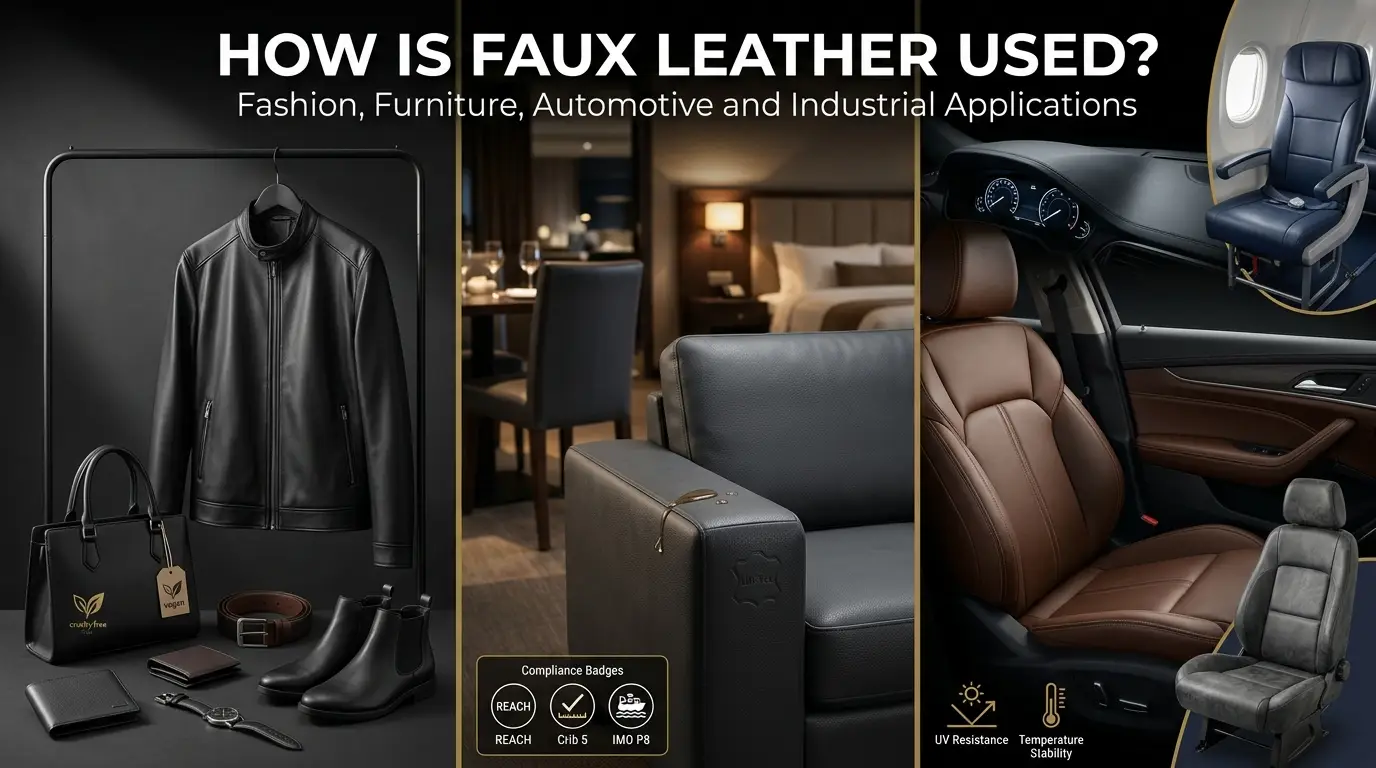
Faux leather applications across fashion apparel, commercial furniture upholstery and automotive car interiors at TV Jackets
Faux leather is one of the most widely used materials in consumer goods manufacturing across multiple industries. Its combination of affordability, water resistance, cruelty-free credentials, and design versatility makes it suitable for a very wide range of applications.
Faux Leather in Fashion and Apparel
Faux leather is used extensively in jackets, bags, belts, wallets, shoes, watch straps, and accessories. In the jacket category specifically, PU leather dominates the affordable to mid-range market, offering a genuine leather appearance at significantly lower cost. For buyers who want the visual identity of a leather jacket without the price premium of full-grain or top-grain genuine leather, or who prefer animal-free materials on ethical grounds, faux leather jackets represent the most accessible option. Browse the complete range of men’s leather jackets at TV Jackets and women’s leather jackets at TV Jackets for character-inspired and fashion-forward outerwear across both genuine and vegan leather constructions.
Faux Leather in Furniture and Upholstery
Faux leather is widely used in sofas, chairs, dining seating, headboards, and commercial hospitality furnishings. PVC leather is particularly dominant in upholstery applications because its harder, more water-resistant surface handles heavy daily use more effectively than PU leather. In commercial environments including hotels, restaurants, healthcare facilities, and transportation aviation, marine, and automotive interiors commercial-grade faux leather meeting REACH compliance, Crib 5 fire safety certification, and IMO P8 marine safety standards is specified for its durability, ease of cleaning, and resistance to spills and contamination. Mercedes-Benz famously rebranded their vinyl leather upholstery as MB-Tex rather than using the PVC or vinyl label, demonstrating how premium brand positioning can reshape consumer perception of synthetic materials.
Faux Leather in Automotive and Industrial Applications
PVC leather is the standard material for automotive dashboard covers, door panels, and mid-range car seat upholstery. PU leather is increasingly used in premium automotive interiors where a softer, more natural feel is required. Faux leather in these applications must meet high standards for UV resistance, temperature stability across extreme ranges, and chemical resistance to cleaners and body oils. The automotive, aviation, and marine industries collectively represent one of the largest global markets for commercial-grade synthetic leather.
How to Tell Faux Leather from Real Leather
Several reliable physical tests allow buyers to distinguish faux leather from genuine leather before or after purchase. These methods are used by experienced buyers, resellers, and textile professionals worldwide.
Watch the video below to see how to identify faux leather from real leather before reading each test in detail.
The Pinch Test
The pinch test is the most immediate and reliable method for distinguishing faux leather from real leather. Press a finger firmly into the material and hold for three seconds. Faux leather is a plastic-coated surface it depresses evenly and returns to its original smooth surface immediately when released. Real leather contains natural collagen fibres that respond to pressure by stretching and wrinkling naturally at the point of contact, then gradually recovering. If the material springs back perfectly flat and shows no natural wrinkling response, it is almost certainly faux leather.
The Smell Test
The smell test is effective and requires no equipment. Genuine leather has a distinctive organic, earthy, slightly animal aroma that is extremely difficult to replicate synthetically. Some manufacturers apply artificial leather scents to faux leather products to confuse buyers, but the underlying smell of faux leather is chemical or plastic in nature particularly noticeable when a product is new. If the material smells of plastic, chemicals, or manufactured fragrance rather than the organic leather aroma, it is faux leather.
The Grain Pattern Test
Inspect the grain pattern closely. Genuine leather is made from animal hide, which has natural variations, irregular pore patterns, subtle blemishes, and no two sections that are exactly identical. Faux leather is produced industrially from a single embossing roller, which stamps the same grain pattern repeatedly across the entire surface with perfect consistency. If every section of the material shows an identical, repeated grain pattern with no natural variation at all, the material is faux leather.
The Backing Test
Examine the underside or backing of the material if accessible. Genuine leather has a rough, fibrous suede-like backing made from the inner surface of the animal hide. Faux leather typically shows either a woven fabric backing clearly textile-like in appearance or a plastic-like clean edge where the polymer layer separates from its backing. If the underside looks and feels like woven fabric or shows a clean plastic cross-section at cut edges, the material is faux leather.
Pros and Cons of Faux Leather
Advantages of Faux Leather
- Affordability: Faux leather costs significantly less than genuine leather to produce, making faux leather jackets, bags, and accessories accessible at a wide range of price points
- Cruelty-free and animal-free: 100% PU and PVC faux leather contains no animal products, making it the dominant choice for vegan and ethical fashion buyers
- Water-resistant: The plastic coating repels light moisture and makes spills easy to wipe clean without staining
- Low maintenance: Faux leather requires no conditioning, no specialist cleaning products, and minimal upkeep compared to genuine leather
- Consistent appearance: Produced industrially, faux leather offers perfectly uniform color and texture across entire product runs unlike genuine leather where each hide varies
- Design versatility: Faux leather can be produced in virtually any color, texture, or pattern, including simulations of exotic animal grains, opening far more design possibilities than genuine leather
- UV resistance: PU faux leather is more resistant to UV fading than genuine leather, making it better suited for items exposed to sustained sunlight
Disadvantages of Faux Leather
- Limited lifespan: Faux leather typically lasts three to five years before cracking, peeling, or discoloring a fraction of the lifespan of quality genuine leather
- Low breathability: The plastic coating traps heat and moisture against the skin, making faux leather significantly less comfortable than genuine leather for extended wear
- No patina development: Faux leather does not age gracefully it degrades rather than developing the natural patina that makes genuine leather more beautiful over time
- Petroleum-based composition: Faux leather is non-biodegradable because it is made from petroleum-derived plastics discarded faux leather can persist in landfill for 200 to 500 years
- Environmental concerns: PVC leather production can release dioxins and phthalates, raising health and environmental concerns beyond the end-of-life disposal problem
- Chemical smell: New faux leather products often carry a plastic or chemical odor that is absent from genuine leather
- Peeling and cracking: As the polyurethane layer breaks down under UV exposure and friction, faux leather peels away from its backing particularly at seams and stress points
The History of Faux Leather
The development of faux leather spans more than a century, driven by the need for affordable leather substitutes during wartime material shortages and the growing commercial demand for cheaper alternatives to animal leather in consumer goods manufacturing.
Presstoff: The First Artificial Leather
Presstoff, one of the earliest forms of artificial leather, was developed in 19th-century Germany from specially treated paper pulp combined with resin binders. The material was pressed and rolled into sheets that superficially resembled leather in appearance and feel. During World War II, Presstoff became widely used as a leather substitute throughout Germany when genuine leather was subject to wartime rationing and military priority. It was used in bookbinding, military equipment, and consumer goods throughout the period.
Naugahyde and the Rise of Synthetic Leather in the 20th Century
Naugahyde, the synthetic leather brand introduced in 1920 by the U.S. Rubber Company, was the first commercially successful alternative to genuine leather in the United States. Initially produced as a rubber-coated fabric material, Naugahyde was refined over the following decades into a PVC-coated product that became the standard synthetic leather for American diners, bars, car interiors, and public seating. During the 1940s, the U.S. Armed Forces adopted Naugahyde for military equipment, expanding its production capacity and establishing vinyl leather as a mainstream consumer material. Rexine, a similar nitrocellulose-based synthetic leather developed in the United Kingdom using camphor as a plasticizer, served an equivalent role in British consumer goods and vehicle interiors through the same period.
DuPont Corfam and Modern Faux Leather Development
DuPont introduced Corfam at the 1963 Chicago Shoe Show and promoted it extensively at the 1964 World’s Fair as a revolutionary synthetic material that would replace genuine leather in footwear. Corfam was a microporous synthetic material made from polyester fibres in a polyurethane matrix it was breathable, water-resistant, and polishable, unlike earlier vinyl alternatives. Despite significant commercial investment, Corfam ultimately failed to displace genuine leather in the premium footwear market because it did not soften and conform to the foot the way genuine leather does. DuPont discontinued Corfam in 1971, but the development process contributed significantly to the technical knowledge that would later drive the mass-market success of PU leather in clothing and accessories.
The Environmental Impact of Faux Leather
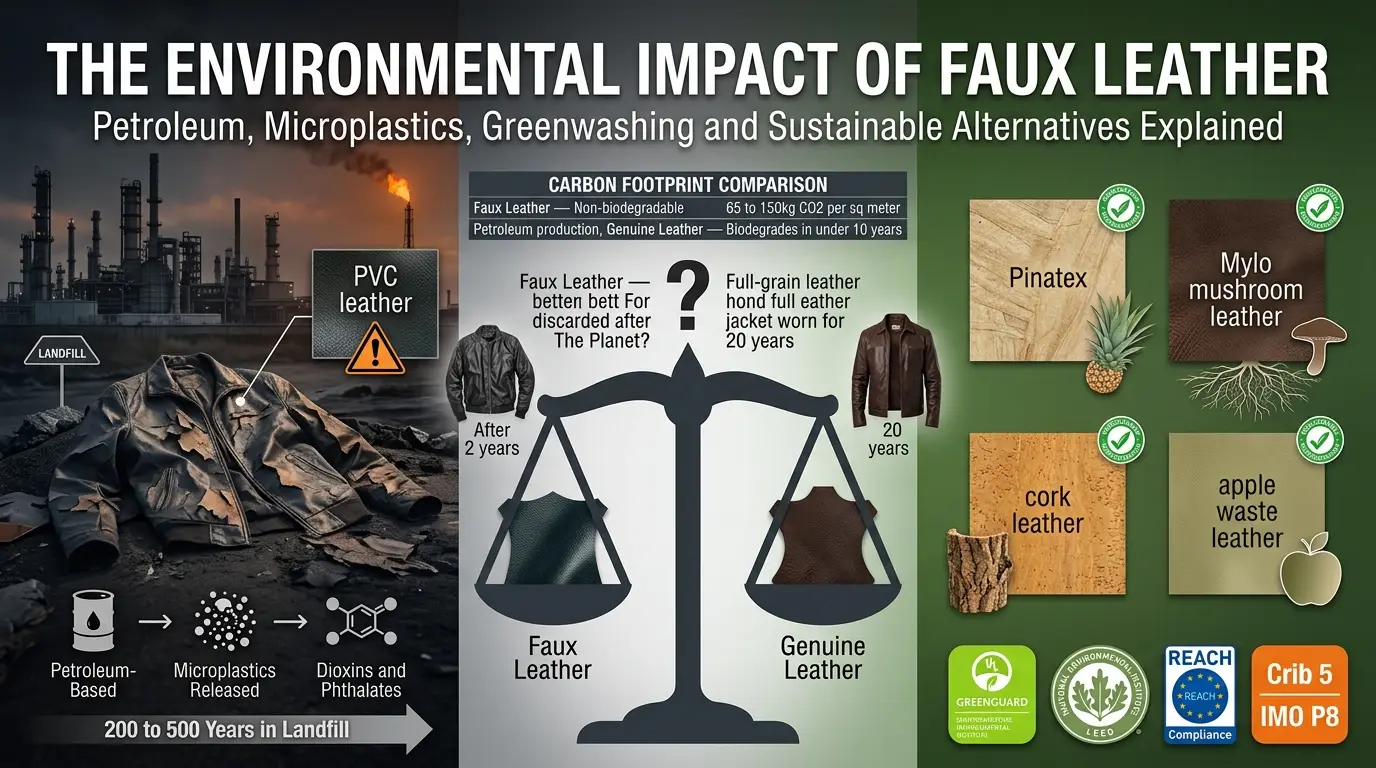
Faux leather environmental trade-off from petroleum-based PU and PVC production to biodegradable sustainable alternatives at TV Jackets
Faux leather is generally not biodegradable because it is made from petroleum-based plastics like polyurethane and polyvinyl chloride. When discarded, these materials may persist in landfills for 200 to 500 years and can release microplastics and toxic chemicals into the environment. PVC leather carries additional environmental concerns because its production involves chlorine-based chemistry that can generate dioxins persistent environmental pollutants and phthalate plasticizers that have been linked to endocrine disruption.
The environmental positioning of faux leather as an eco-friendly alternative to genuine leather is more complicated than it initially appears. Genuine leather has a high production carbon footprint driven by cattle farming methane emissions, land use, and the chemicals used in chrome tanning approximately 65 to 150 kilograms of CO2 equivalent per square meter depending on the production method. However, vegetable-tanned genuine leather biodegrades within a decade, giving it a significantly lower end-of-life environmental footprint than petroleum-based faux leather. A faux leather jacket discarded after two years of use has a higher total environmental cost than a full-grain leather jacket maintained for twenty years, even accounting for the production footprint difference.
Sustainable faux leather alternatives including Pinatex, Mylo mushroom leather, cork leather, and apple waste leather offer genuinely lower environmental footprints than both petroleum-based faux leather and conventional animal leather. These materials are biodegradable, derived from agricultural by-products or renewable biological sources, and carry no petroleum dependency. They remain more expensive and less available than PU or PVC leather but represent the most environmentally responsible direction for the synthetic leather industry.
Certifications to look for when purchasing premium faux leather include Greenguard Environmental Institute certification for low chemical emissions, LEED compliance for sustainable production practices, and REACH compliance for EU chemical safety standards. Commercial-grade synthetic leather used in aviation, marine, and healthcare applications may also carry Crib 5 fire safety certification and IMO P8 marine safety certification.
How to Clean and Care for Faux Leather
Faux leather is significantly easier to maintain than genuine leather and requires no specialist leather care products or conditioning treatments. The polyurethane or PVC surface repels most liquid spills and can be wiped clean with minimal effort.
- Daily cleaning: Wipe with a soft damp cloth to remove surface dust, light dirt, and fresh spills before they dry
- Deeper cleaning: Mix a small amount of mild soap with warm water and apply with a soft non-abrasive cloth. Wipe the surface gently and dry with a clean cloth afterwards
- What to avoid: Acetone, bleach, harsh chemical cleaners, and oil-based leather conditioners all degrade the polyurethane coating and accelerate cracking and peeling
- No conditioning required: Unlike genuine leather, faux leather has no natural collagen fibres to moisturise. Applying genuine leather conditioner to faux leather provides no benefit and may damage the surface coating
- Sunlight and heat: Store faux leather away from direct sunlight and heat sources. Prolonged UV exposure and heat accelerate the breakdown of the polymer layer, causing brittleness, cracking, and color loss significantly faster than in a cool, shaded environment
- Storage: Store in a cool, dry place in a breathable dust bag or on an open shelf. Never store in plastic bags or airtight containers as moisture buildup can cause mold on the fabric backing layer
Final Thoughts
Faux leather is a genuinely useful material for buyers who want a leather-like appearance at an accessible price, prefer cruelty-free and animal-free products, or need water-resistant outerwear that is easy to clean and maintain. Its advantages affordability, ethical credentials, low maintenance, and design versatility make it the dominant choice in the accessible fashion market. Its limitations shorter lifespan than genuine leather, low breathability, inability to develop patina, and a complicated environmental footprint are equally real and worth understanding before purchasing.
The category of faux leather is also not monolithic. PU leather, PVC leather, microfiber leather, silicone leather, and plant-based alternatives like Pinatex and Mylo are all faux leather in the sense that none of them use animal hide but they differ substantially in feel, performance, sustainability, and appropriate application. Understanding which type of faux leather a product uses is as important as understanding the difference between faux leather and genuine leather.
For buyers who want to understand the complete landscape of leather types and grades before deciding from full-grain to bonded leather and every synthetic alternative the complete what is leather made of guide at TV Jackets covers every material in one place. And for the complete guide to polyurethane leather specifically the most common type of faux leather read the what is PU leather guide at TV Jackets.
