
The Masters Green Jacket Story & Style Guide

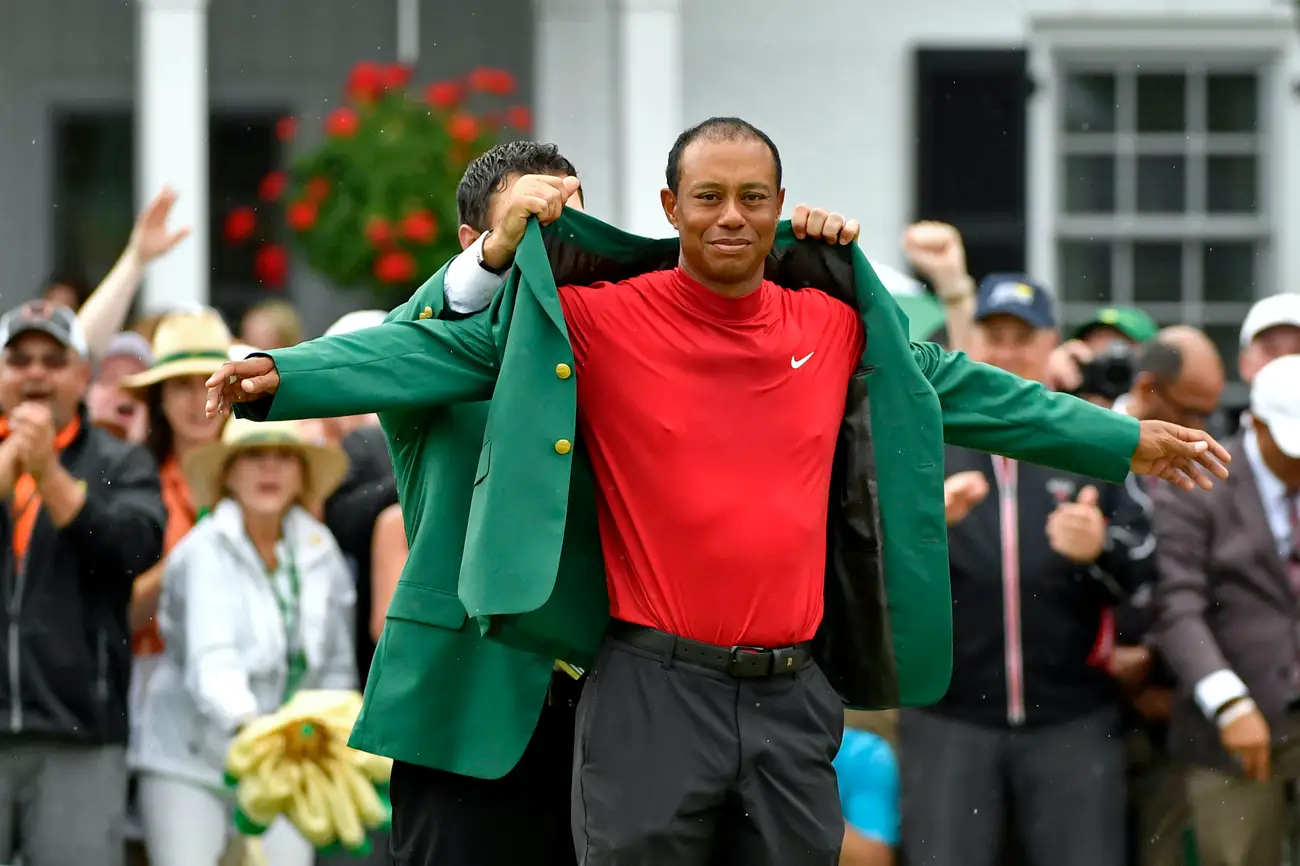
No piece of clothing in professional sport carries more weight than the Masters green jacket. It is not a medal. It is not a trophy. It is a blazer, and yet for eight decades it has been the single most recognised symbol of excellence in golf. Every April, one player earns the right to slip it on at Augusta National Golf Club, and that image travels around the world within seconds. This guide covers everything: what the jacket is, the strict rules around it, who gets one, who puts it on the winner, and what you can do if you want to wear that distinctive shade of green yourself.
The Masters green jacket is a single-breasted wool blazer in Pantone 342, known as Augusta Green, awarded each year to the winner of the Masters Tournament at Augusta National Golf Club. First presented to a champion in 1949, it is considered the most coveted prize in golf. Champions may take the jacket off-site for one year; after that, it must remain stored at the club. The Golf Club Masters Green Jacket at TVJackets lets you wear that look without any of the restrictions.
Table of Contents
What Is the Masters Green Jacket?
The Masters green jacket is the official prize of the Masters Tournament, one of golf’s four major championships. Held annually at Augusta National Golf Club in Augusta, Georgia, the Masters is widely regarded as the most prestigious event on the golf calendar, and the green jacket is what its winner earns.
The jacket is not a symbolic prop. It is a specifically designed, custom-tailored blazer made from tropical-weight wool in a colour that Augusta National trademarked: Pantone 342, referred to simply as Augusta Green. Winners receive one during the presentation ceremony at the conclusion of each tournament, and the tradition has continued without interruption since 1949.
What makes it different from every other prize in sport is what it represents beyond the tournament itself. It signifies honorary membership in one of the most exclusive golf clubs on earth. It is a wearable credential: not just a trophy you put on a shelf, but a garment with rules attached that persist long after the tournament ends.
A Short History of the Green Jacket at Augusta
The green jacket did not begin as a champion’s prize. When Augusta National Golf Club was founded in the early 1930s by Bobby Jones and Clifford Roberts, club members wore green jackets so that visitors and patrons could easily identify someone to approach with questions. The jacket was a member’s identifier, not a competitive award.
In 1937, the green jacket became the official uniform of Augusta National members. For over a decade, champions were not given one at all. That changed in 1949, when Sam Snead became the first Masters winner to receive a green jacket as part of the victory ceremony. Previous champions were retroactively presented with theirs in the years that followed.
By the 1960s, the jacket presentation ceremony had become the defining image of the tournament. The sight of one player helping another into the jacket, the outgoing champion dressing the new one, created a ritual that now defines how the Masters ends every April. The tradition has been observed consistently since it became formalised and stands today as one of the most watched moments in televised sport.
Who Gets a Masters Green Jacket?
Two groups of people receive a Masters green jacket: Augusta National Golf Club members and Masters Tournament champions. Beyond those two groups, no one else is officially issued one.
For club members, the jacket is part of membership and must remain at the club at all times. Members wear it on the grounds but it does not leave Augusta National, not for dinners, not for travel, not for public appearances. The member jacket is purely an on-site credential.
For champions, the rules are slightly different but still strict. A champion receives their jacket at the end of the tournament and is permitted to take it away from the club for one year. After that single year, the jacket must be returned to Augusta National and stored in a cedar closet assigned specifically to that winner. From that point forward, a champion may only wear their jacket on the club’s grounds or during Masters week.
Shop the Golf Club Masters Green JacketThe Rules: What Champions Can and Cannot Do
Augusta National enforces its green jacket rules with the kind of seriousness you would expect from one of the most tightly run organisations in sport. The rules are not guidelines. Champions who have violated them publicly have faced real consequences.
- The one-year off-site rule: The reigning champion may take the jacket home for one year after their victory. After that year ends, it must return to the club.
- Club-grounds wearing only: After the first year, a champion may only wear the jacket when visiting Augusta National or during Masters week.
- Dress code when worn publicly: During the victory year, the jacket must be worn with a white shirt, club tie, dress trousers, and dress shoes. Trainers are not permitted.
- No alcohol in photographs: Public images of the jacket alongside alcohol are strictly prohibited.
- One jacket per champion: Even a six-time winner like Jack Nicklaus only ever has one jacket, unless sizing requires a new fitting.
- Non-transferable: The jacket cannot be sold, lent, or transferred to anyone outside the Augusta National membership.
- No public auction: Augusta National actively moves to contain any authentic jackets that appear on the secondary market.
These rules explain why sightings of the jacket outside Masters week are genuinely rare. The champions themselves must comply or risk a complicated relationship with the club.
Design Details: Colour, Cut, and Construction
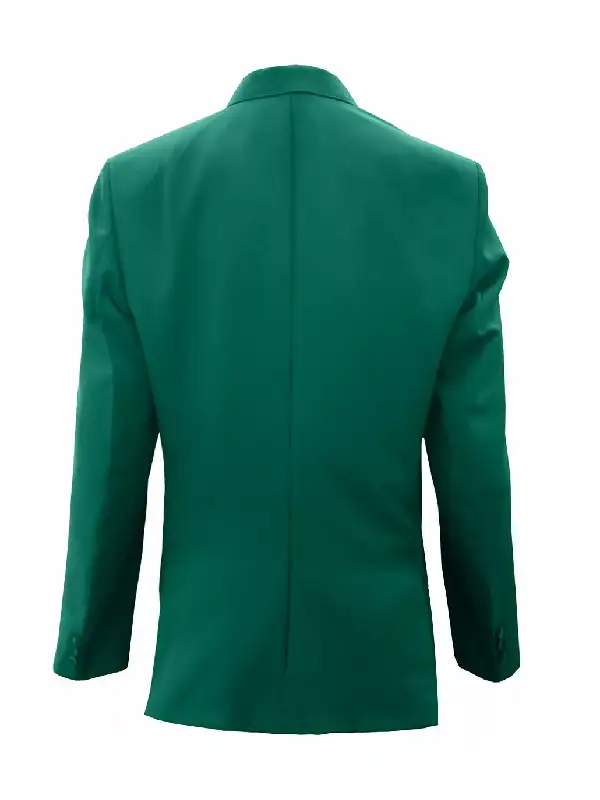
The Masters green jacket is not made by a major fashion house. It is produced by Hamilton Tailoring Company, a Cincinnati-based tailor that has been crafting the jackets since 1967. Each jacket takes approximately one month to complete and uses roughly 2.5 yards of tropical-weight wool, a lightweight material suited to the warm Georgia spring weather during tournament week.
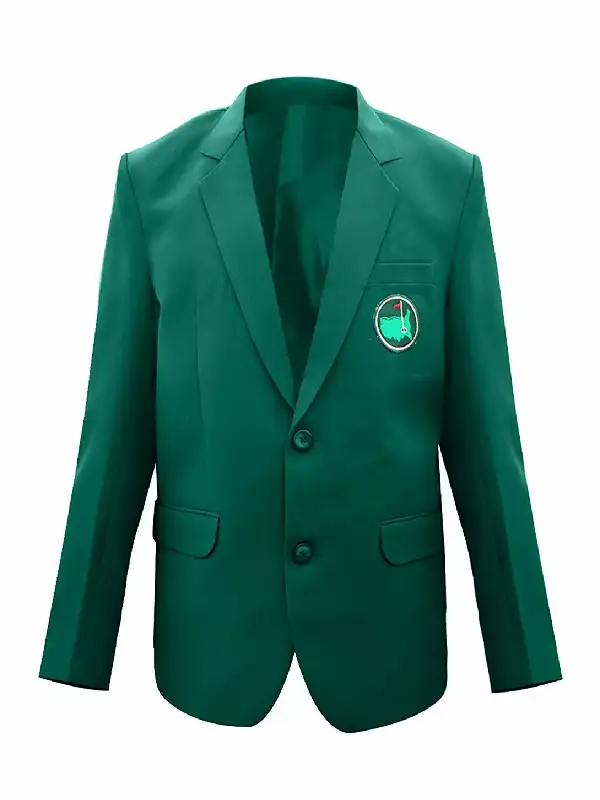
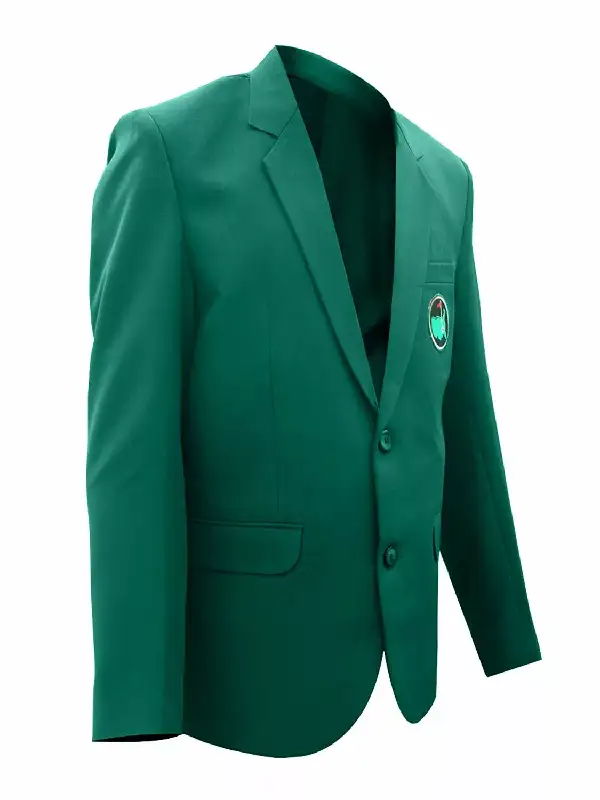
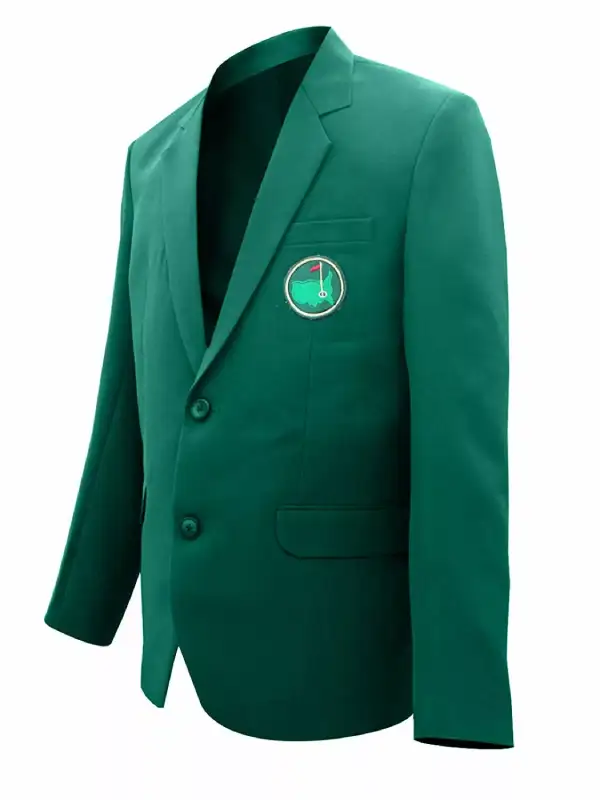
The cut is single-breasted with three gold-plated brass buttons, each embossed with the Augusta National Golf Club logo. A custom embroidered club logo patch is stitched onto the left breast pocket. The specific shade, Pantone 342 Augusta Green, is trademarked, which is why no retailer can legitimately claim to offer the exact official colour in an officially sanctioned product.
The jacket is tailored to each champion specifically. Augusta National keeps measurements on file and adjusts as needed over the years, which is how the club is always ready to present a properly fitting jacket to the winner on the Sunday afternoon of tournament week.
Who Puts the Green Jacket on the Winner?
The presentation ceremony is one of the most watched moments in sport every April. By tradition, the previous year’s champion places the green jacket on the new winner in the Butler Cabin at Augusta National, immediately after the final round concludes. It is a formal, quiet moment: not a stage-managed spectacle, simply one champion recognising another in a room full of history.
The ceremony has its own visual grammar that golfers and fans read immediately. The standing champion holds the jacket open, the new winner slips their arms through, and both straighten briefly before the moment is photographed for broadcast around the world. The whole exchange takes under thirty seconds and says everything.
There is one well-known exception to the outgoing-champion tradition. If the defending champion wins back-to-back, they cannot put the jacket on themselves. In that situation, the Augusta National Chairman steps in and performs the ceremony. As of the 2026 Masters, that would be Chairman Fred Ridley. Only three golfers in history have defended their title in consecutive years: Jack Nicklaus in 1966, Nick Faldo in 1990, and Tiger Woods in 2002.
In 1966, Nicklaus having won as defending champion and having no predecessor to handle the moment is reported to have placed the jacket on himself, one of the tournament’s more unusual historical footnotes. From that point, the Chairman convention was formalised for exactly this scenario.
How Many Green Jackets Does Tiger Woods Have?
Tiger Woods has won the Masters five times, in 1997, 2001, 2002, 2005, and 2019, but like all champions he only has one green jacket. Augusta National’s rules specify that even multiple winners retain just one jacket, with re-fittings carried out as needed as a champion ages. The garment follows the champion through their career rather than being issued anew for each victory.
Jack Nicklaus holds the record with six Masters titles, in 1963, 1965, 1966, 1972, 1975, and 1986, and he too holds one jacket. Arnold Palmer won four times. Gary Player won three. Phil Mickelson won three. None of them have more than one jacket regardless of how many times they lifted the trophy at Augusta.
This single-jacket rule is part of what makes the ceremony so distinctive. The jacket is not a record of victories: it is an identity. A champion wears the same jacket they first put on, regardless of what they have achieved since. It is in some ways the most elegant aspect of the entire tradition.
Can You Buy a Masters Green Jacket?

The official Augusta National green jacket is not available for sale to the public under any circumstances. Augusta National has filed legal action to block the sale of jacket materials, and authentic club-issued jackets are never sold through official channels. Any listing claiming to be an “official” or “club-issued” jacket should be treated with serious scepticism.
Rare exceptions exist in the secondary auction market. In 1994, a journalist discovered an authentic 1950s-era green jacket in a Toronto thrift store, having apparently left the club decades earlier. That jacket eventually sold at auction in 2017 for nearly $140,000. Such instances are genuinely exceptional and Augusta National has consistently moved to contain them when they become public.
What you can do is wear the look. Tournament-inspired green blazers built to capture the silhouette, structure, and colour of the Masters jacket are made for golf fans and style enthusiasts who want to connect with the aesthetic without the restrictions that come with the actual garment. That is exactly what the Golf Club Masters Green Jacket at TVJackets was designed to deliver.
The Golf Club Masters Green Jacket at TVJackets
Golf Club Masters Green Jacket
Tournament-inspired. Single-breasted cut. That unmistakable Augusta shade of green. Built for the fan who wants to wear the look, not just watch it on a Sunday in April.
View the JacketThe Golf Club Masters Green Jacket at TVJackets is built around the same visual language that makes the original so instantly recognisable: a clean single-breasted silhouette, structured shoulders, a formal lapel, and that deep distinguished green that every golf fan knows on sight. It is a jacket for wearing, to the course, to a watch party, to any setting where that particular shade of authority and accomplishment makes a statement.
Unlike the club-issued garment with all its restrictions, this is a jacket you can put on whenever you like, wear wherever you choose, and style exactly as you see fit. The look was designed for the golf fan who takes the game seriously and knows that presentation matters as much off the course as it does on it.
Frequently Asked Questions
What is the Masters green jacket and why is it significant?
The Masters green jacket is a single-breasted wool blazer in Pantone 342 Augusta Green, awarded annually to the winner of the Masters Tournament at Augusta National Golf Club. It has been presented to champions since 1949 and is widely considered the most coveted prize in professional golf. Beyond its value as a trophy, it also represents honorary membership in one of the most exclusive golf clubs in the world, which is why the rules around wearing it are specific and strictly enforced.
Who puts the green jacket on the Masters winner?
By tradition, the previous year’s Masters champion places the green jacket on the new winner during the presentation ceremony at Butler Cabin. If the defending champion wins back-to-back, they cannot put the jacket on themselves: the Augusta National Chairman steps in to perform the ceremony instead. As of 2026, Chairman Fred Ridley would fulfil that role. Only Jack Nicklaus in 1966, Nick Faldo in 1990, and Tiger Woods in 2002 have won the Masters in consecutive years.
Do Masters winners get to keep the green jacket?
Champions may take the jacket off-site for one year following their victory. After that year, it must be returned to Augusta National and stored in a cedar closet assigned to that winner at the club. From that point, the champion can only wear their jacket on the club’s grounds or during Masters week. The jacket remains the property of Augusta National at all times, with champions holding possessory rights rather than full ownership.
What colour is the Masters green jacket?
The official colour is Pantone 342, referred to as Augusta Green. It is a mid-tone, slightly warm shade of green, deep enough to read as formal and authoritative but not so dark that it loses its distinctiveness on camera. The hex code most commonly associated with Pantone 342 is #00563B. The specific shade is trademarked by Augusta National.
Who makes the Masters green jacket?
Since 1967, the Masters green jacket has been made by Hamilton Tailoring Company, based in Cincinnati, Ohio. Each jacket uses approximately 2.5 yards of tropical-weight wool suited to the warm Georgia spring climate and takes around one month to complete. Augusta National keeps measurements on file for every champion so the jacket fits correctly at the presentation ceremony, with adjustments carried out as needed over the years.
How many green jackets does Tiger Woods have?
Tiger Woods has won the Masters five times, in 1997, 2001, 2002, 2005, and 2019, but like all champions he only has one green jacket. Augusta National’s rules specify that even multiple winners retain just one jacket, with re-fittings carried out as needed. Jack Nicklaus won the Masters six times and similarly holds one jacket. The garment follows the champion across their career rather than being issued anew for each victory.
What are the rules for the Masters green jacket?
The key rules are: the reigning champion may take the jacket off-site for one year only, after which it must be returned to Augusta National; from that point the champion may only wear it on club grounds or during Masters week; it must be worn with a white shirt, club tie, dress trousers, and dress shoes when worn publicly during the victory year; no alcohol may appear alongside it in photographs; it cannot be sold or transferred; and each champion only ever receives one jacket regardless of how many times they win.
Where can I buy a Masters-style green jacket?
The official Augusta National green jacket is not sold publicly under any circumstances. Tournament-inspired versions built to capture the silhouette, structure, and colour of the Masters look are available for golf fans and style enthusiasts. The Golf Club Masters Green Jacket at TVJackets is designed to deliver the Masters aesthetic in a jacket you can wear without restriction, wherever and whenever you choose.
The Masters green jacket is more than the prize at the end of four days at Augusta National. It is a tradition, a uniform, a set of rules, and a cultural symbol that has grown more powerful with every decade of the tournament’s history. Understanding what it is, where it came from, who gets one, and what you can and cannot do with it, only deepens the appreciation for why that single image of a champion slipping it on still stops the world every April.
The rules that surround the official jacket are part of what give it its meaning. A garment you can only wear at a specific place for a specific week out of every year is not just a jacket: it is a credential, a restraint, and a privilege simultaneously. Nothing else in sport works quite like it.
And if you want to carry that energy beyond the television screen, the Golf Club Masters Green Jacket at TVJackets lets you wear the look with no restrictions attached. Augusta-influenced, tournament-inspired, and available to wear any Sunday you choose.
